
The surround is a drainage question before it's a turf question
The core rule for laying turf on any hard surface applies to a pool surround too, and it applies harder: water needs somewhere to go. Our guide to turf on concrete and pavers covers the hose test in detail, and the same test works here. Wet the surround down on a dry day and watch where the water travels. It should head towards a grate, a garden bed or the edge of the paving, not sit in a low patch.
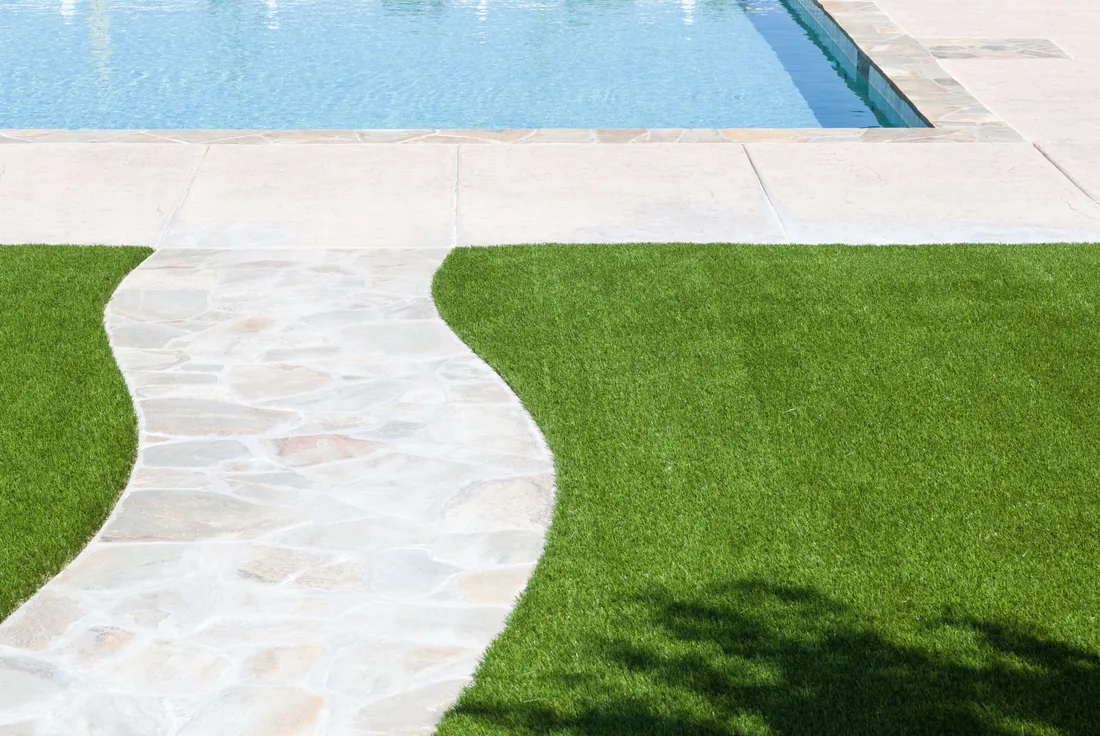
What makes a pool surround different is the extra water it carries. Splash-out, kids getting in and out, towels being wrung and hosed off, all of that lands on the same paving that rain does, but more often and more concentrated near the coping. A surround that drains rain adequately can still be marginal once you add daily pool use to the load. It is worth checking the fall closest to the coping specifically, not just the surround as a whole, because that is the zone doing the most work.
If the surround already falls cleanly away from the pool, you are starting from a good position. If it has a low spot, a section that has settled, or a drainage point that is silted up or half-buried under an old paver, that gets fixed first. Turf laid over a surround that ponds will hide the puddle, not remove it, and a pool deck is the last place you want standing water sitting under the surface unnoticed.
Fixing the turf at the coping edge
Coping is a hard, sealed edge, so the mechanical fixings used on a soil lawn, pegs driven into the ground at intervals, are not an option here. The method is the one used on any concrete, paved or tiled job: turf adhesive along the perimeter and every join, with a foam underlay under the sheet to take the hardness out of the surface underfoot and smooth over minor irregularities in the paving.
The coping edge itself deserves more care than an ordinary courtyard perimeter, for a simple reason: it is the busiest, wettest strip on the whole job. Every swimmer crosses it, repeatedly, dripping. A glue line that lifts or a join that starts to fray at that specific edge is both the most visible flaw on the site and the one that gets tested hardest. Expansion joints in the surrounding concrete keep moving underneath the turf the same way they do on any slab, so they need to be planned around rather than glued over and forgotten. Fixed edges around the pool shell, steps or a spa also need a clean plan for how the turf terminates, since there is no soil edge to tuck it into.
Heat off the water: a real but secondary concern in Melbourne
Artificial turf runs hotter than living grass, and a hard base underneath it makes that worse, because the base absorbs heat through the day and re-radiates it up into the turf. Around a pool there is an additional factor: light reflecting off the water surface can add to that surface heat on a bright, still day. Western Sydney University researcher Dr Sebastian Pfautsch has measured unshaded artificial turf getting close to 100°C in direct summer sun in his studies, and manufacturers including TigerTurf acknowledge turf gets warm, generally staying below the extremes of bare asphalt or concrete but still warm enough to notice underfoot.
In Melbourne this sits as a real but secondary consideration rather than the dominant one. The city's cooler, more variable climate and shorter run of extreme-heat days mean it bites on fewer days of the year than it does further north, but a north-facing pool deck with no shade on a February scorcher will still be uncomfortable barefoot. The mitigations are the same ones that work on any hard-surface job: shade over part of the deck, hosing the area down before use, and a lighter-coloured turf, which runs cooler than a dark one as a matter of straightforward physics. Some suppliers market cooling infills and yarns with specific percentage claims attached; treat those as the supplier's own claim and ask for their test data rather than taking the figure as settled.
Bluestone decks, established gardens and Melbourne's frost season
Plenty of Melbourne's older pools, particularly in the leafier established suburbs, sit inside a bluestone or natural-stone surround laid decades ago rather than a poured concrete slab. The check is the same as for any paved job: rock a few flags with your foot. Stone that tips, rocks or has sunk relative to its neighbours will keep doing that under the turf, and irregular bluestone joints, which are often wider and less uniform than a modern paver run, usually need filling so they don't read through as lines.
Frost is a genuinely Melbourne consideration that Sydney and Brisbane pool surrounds don't share to the same degree. A shaded, south-facing deck will simply take longer to dry out on a frosty winter morning than a north-facing one, the same as bare bluestone or concrete always has. It's a fact worth planning around on a shaded site, not a defect in the turf.
Worth noting too: Victoria's Permanent Water Saving Rules restrict sprinklers and garden watering systems to 6pm–10am statewide, a permanent rule that's been in place since 2011. That governs lawn and garden watering, not a pool's own reticulated top-up, so it isn't directly about the pool. Where it does matter is the comparison: a living grass surround would need watering within those hours to stay green, while an artificial one needs none, which removes the question rather than working around it.
No mud, no clippings, less to manage by the water
The practical case for turf around a pool is straightforward. There's no mud tracked from a soggy lawn edge onto the coping and into the water. There are no grass clippings drifting in after mowing, which is a genuine nuisance next to a pool and one real grass right at the water's edge makes worse. And there's no mowing close to the pool shell at all, a job most people already avoid or do carefully with an edge trimmer.
Ongoing care is the same light routine as any turf installation: a monthly brush to keep the pile standing, clearing leaf litter and debris so it doesn't sit and hold moisture against the backing, and an occasional check that drainage points near the coping stay clear. None of it compares to mowing, edging and re-seeding a strip of real lawn that gets walked on wet every single day it's used.
Cost follows Melbourne's usual hard-surface pricing rather than a separate pool rate; our Melbourne artificial grass cost guide sets out the budget, mid and premium tiers, and a surround needing drainage or bluestone work first will sit above those figures until someone has assessed it.
Pool surround questions we get asked most
Can artificial grass be laid right up to a pool edge?
Yes, and it is one of the more common pool-surround jobs in Melbourne. The turf itself is indifferent to the water sitting next to it. What matters is the same thing that matters on any hard-surface job: does the surround already fall away from the pool and towards a drain or garden bed, or does it hold water. A coping that sheds water cleanly is a good base to work with. One that ponds needs that sorted before turf goes anywhere near it.
Does a pool surround need more attention to drainage than an ordinary paved area?
Generally yes, because a pool surround carries an extra water load an ordinary courtyard never sees: splash-out from swimmers, kids jumping in, and the general business of people getting in and out wet. That water has to reach the same drainage points the bare coping uses now. If turf ends up sitting over a low spot that never used to matter because bare concrete or pavers dried quickly, it will matter once turf is holding moisture against the surface.
How is artificial grass fixed at the edge of pool coping if you can't peg into it?
The same way it is fixed to any concrete, paved or tiled edge: turf adhesive along the perimeter and every join, not pegs. Coping is a hard, sealed edge, so there is nothing to drive a peg into, and the coping edge is also the part of a pool surround that takes the heaviest, wettest foot traffic of the whole job, which is exactly why a clean, well-bonded finish there matters more than almost anywhere else on the site.
Is a foam underlay needed on a pool deck the same as on a concrete courtyard?
Most installers use one, for the same two reasons as any hard-surface job: it takes the dead hardness out of a slab or paved surface, and it smooths over trowel marks or paver edges so they don't telegraph through the turf. Around a pool that comfort factor matters more than usual, since bare feet are the norm rather than the exception.
Does artificial grass get hotter next to a pool because of the water?
Reflected light off a pool surface can add to the surface heat of turf on a deck, on top of the heat any hard base underneath already holds and re-radiates. It is a genuine secondary factor rather than the main issue Melbourne installers see, which tends to be drainage. Shade, hosing the area down before use and choosing a lighter-coloured product all help, the same mitigations that apply to any hard-surface turf job in full sun.
Our pool surround is bluestone. Does that change anything?
Bluestone and other paved pool surrounds are common around established Melbourne pools, and the main check is the same as for any paver job: rock a few pavers or flags with your foot. Anything that tips, rocks or has settled unevenly will keep moving under the turf and needs relaying or a level screed first. Wide or irregular bluestone joints usually need filling too, or they show through as lines.
Do Victoria's water restrictions affect an artificial turf pool surround?
Victoria's Permanent Water Saving Rules govern sprinklers and garden watering systems, which are restricted to 6pm to 10am statewide, and hand-held hoses with a trigger nozzle, which can be used anytime. That is about lawn and garden watering, not a pool's own reticulated top-up. A living grass surround would be bound by the sprinkler hours if it needed regular watering; artificial turf around a pool needs none at all, which sidesteps the question rather than answering it.
Does a Melbourne winter or frost cause problems on a pool deck?
Nothing specific to the turf itself. A shaded, south-facing pool surround will simply take longer to dry out after a frosty or overcast Melbourne morning than one in full sun, the same as any hard surface would, bare pavers included. That is a general seasonal fact worth knowing for a shaded deck, not a defect in the product.
Is turf around a pool a DIY job?
It can be, if the coping and surround already drain well and the shape is simple. The coping edge itself is the part worth being fussy about, since a rough or lifting glue line there is both the most visible spot on the job and the one under the most foot traffic. A surround with ponding, an awkward curve around the pool shell, or a bluestone edge that needs relaying first is a better candidate for a professional install.
What does artificial grass around a pool cost in Melbourne?
Pricing follows the same Melbourne-wide tiers as any hard-surface install; see our full cost guide for the budget-to-premium breakdown. A straightforward pool surround with good existing fall sits in normal territory for a hard-surface job. A surround needing drainage work, bluestone relaying or a screed to fix a low point costs more, which your installer will confirm once they have seen it.
Get a quote for turf around your pool
Free, no obligation. Tell us about your surround and a vetted local installer confirms an exact price after seeing the space. This is a quotes and information service, not an installer: enquiries go to one vetted Melbourne installer, and you can also see what a proper installation over a hard surface involves before you ask for a price.
Get a free, no-obligation quote
Tell us a little about your job and we'll pass it to a vetted local installer.